
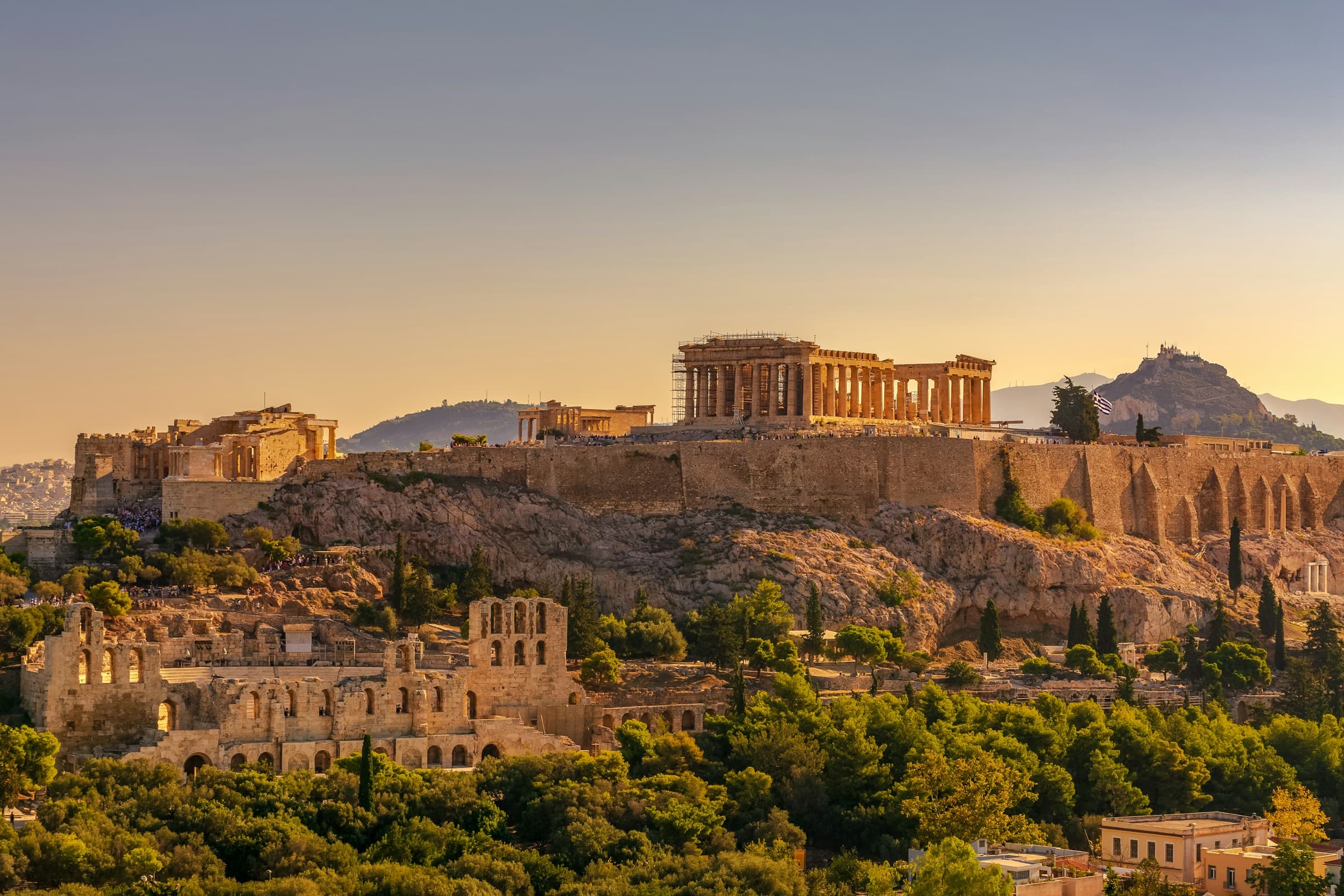
The Acropolis, layered ancient sites and old neighbourhoods in a walkable capital
Athens
Athens gathers the Acropolis, the Ancient Agora and a clutch of major museums into a centre you can cross on foot, with island ferries and flights close by.
The ancient city in a walkable centre
Athens is worth two full days on almost any Greece itinerary, and three if you like museums. Its main ancient sites sit within walking distance of each other around one rock: the Acropolis, a UNESCO World Heritage Site since 1987, where the Parthenon, the Erechtheion and the Propylaia stand above the modern city. A pedestrian route circles the hill and links it to the Ancient Agora, the Roman Agora and Hadrian's Library, so you can cover a great deal on foot without using transport at all.
What to see beyond the Parthenon
The Acropolis Museum, at the foot of the hill, holds the sculptures found on the rock and makes far more sense of the site if you visit it on the same day. Its ticket is separate from the Acropolis ticket. North-west of the hill, the Ancient Agora was the centre of political, commercial and social life in the ancient city. The Temple of Hephaestus, a Doric temple from the 5th century BC, stands on its western edge, and the rebuilt Stoa of Attalos houses the site museum. The Roman Agora, with the Tower of the Winds, and Hadrian's Library, built in 132 CE, are a few minutes away beside Monastiraki. To the south-east, fifteen columns of the Temple of Olympian Zeus still stand, and Kerameikos, the ancient cemetery, is the quietest of the central sites.
Between the monuments, Plaka is the city's oldest neighbourhood and wraps around the base of the Acropolis. Above it, Anafiotika is a cluster of whitewashed, island-style houses built in the 19th century by builders from the island of Anafi. For views, Philopappos Hill looks straight across at the Parthenon, and Lycabettus, reached on foot or by cable car, is the higher lookout over the whole city.
Getting in and around
Metro Line 3 runs from Athens International Airport to Syntagma in about 40 minutes and continues to the port of Piraeus, which matters if you are connecting to a ferry. For the Acropolis, take Line 2 to Acropolis station, or Lines 1 and 3 to Monastiraki. Admission prices for the Acropolis and its museum are listed below, dated to the day we checked them.
Timing your visit
The Acropolis opens at 08:00 all year. It closes at 20:00 from April to August, earlier through the autumn, and at 17:00 from November to March. The rock has almost no shade, so in July and August, the hottest months, go at opening time or in the last two hours of the day. The ticket covers the hilltop and the slopes but allows one entry only, so see the Theatre of Dionysus on the south slope on your way up or down rather than leaving and returning.
Where Athens fits
Most travellers pair the capital with an island. Our Santorini & Athens itinerary spends two days here before a short flight to Santorini, and the wider Greece guide covers when the islands are at their best. With an extra day, Delphi is about two and a half hours away by road, and the Temple of Poseidon at Cape Sounion stands at the southern tip of Attica.
- Acropolis of Athens and slopes, full single-entry ticket
- EUR 30 (reduced: EUR 15)Checked Oct 6, 2026
- Acropolis Museum, general admission
- EUR 20 (reduced: EUR 10)Checked Oct 6, 2026
Plan a trip to Athens
Plan My TripWhen to go
Spring and autumn are the most comfortable seasons for walking the open-air sites: April to June and September to October are warm without the midsummer heat. July and August are the hottest months and the Acropolis has very little shade, so plan site visits for early morning or late afternoon. From November to March the sites close earlier, at 17:00, but the city is quiet, and state-run archaeological sites are free on the first and third Sunday of each month.
Things to do
- 01
Climb the Acropolis early
Be at the gate for the 08:00 opening to see the Propylaia, the Erechtheion and the Parthenon before the heat and the largest groups arrive.
- 02
Spend an afternoon in the Acropolis Museum
See the sculptures from the rock at eye level, with the Parthenon itself in view through the glass of the top-floor gallery.
- 03
Walk the Ancient Agora
Cross the old civic centre from the Stoa of Attalos and its museum to the Temple of Hephaestus, a Doric temple from the 5th century BC.
- 04
Watch the light from Philopappos Hill
Follow the paths up through the pines for a level view across to the Parthenon, with Lycabettus rising behind it.
FAQs
How many days do you need in Athens?
Two full days cover the Acropolis and its museum, the Ancient Agora and the neighbourhoods of Plaka and Monastiraki at an unhurried pace. A third day gives you time for the National Archaeological Museum or a day trip to Delphi or Cape Sounion.
Does the Acropolis ticket include the Acropolis Museum?
No. The Acropolis ticket covers the hilltop and its slopes and allows one entry only. The Acropolis Museum is run separately and has its own ticket.
Who gets free entry to the Acropolis?
The Ministry of Culture lists free admission for children and young people up to 25 from EU member states and for children up to 18 from non-EU countries, with proof of age. State-run sites are also free on a handful of dates each year, including 6 March, 18 April, 18 May, the last weekend of September, 28 October, and the first and third Sunday of each month from November to March.
How do you get from Athens airport to the city centre?
Metro Line 3 runs directly from the airport to Syntagma in about 40 minutes and continues to Piraeus. Express buses also run from the airport to Syntagma and to the port, and take longer.
You might also like


Ready for your next adventure?
Let's Plan Your Dream Trip
Whether you're looking for a weekend escape or an unforgettable journey, SafiriFlow can help you plan it.
Start Planning